


Everything in the web world is changing at a breakneck pace. With the advent of AI-generated websites, no-code development platforms, automated SEO tools, one-click deployment services, and the commoditization of web hosting, it is becoming even harder to stand out as the better provider. That’s why we’ve started incorporating a competitive analysis into our pre-proposal process.
The truth is (and so many don’t realize this), the difference between winning and losing a client often comes down to preparation. While many agencies rush from a brief discovery call straight to proposal, the most successful ones know there’s a critical step in between that dramatically increases their win rate: competitive analysis.
This also helps YOU decide if the client is worth your while BEFORE spending hours on a proposal.
The Missing Link in Your Website Proposal Process
Does this sound familiar?
A prospect reaches out, you have a quick 5-minute discovery call, and then you immediately start drafting a proposal based on that brief conversation.
This common approach leaves you vulnerable to misunderstanding the client’s true needs and missing crucial context about their market position.
What if instead, you could walk into your pre-proposal meeting armed with insights that demonstrate you understand not just their business, but their entire competitive landscape? This level of preparation signals to prospects that you’re thorough, strategic, and genuinely invested in their success.
Asking the client to schedule a pre-proposal meeting after you’ve done a CA only emphasizes your professionalism.
And the good news is, you can use AI to make this a virtually painless and time-effective process. But more about that later. First, let’s look at a few more powerful advantages of doing a competitive analysis before fully interviewing the prospect.
How Competitive Analysis Improves Discovery and Requirements
When you analyze a prospect’s competitors before your main meeting, you gain several powerful advantages:
You Speak Their Language
Every industry has its own terminology, priorities, and pain points. Competitive analysis helps you understand the vocabulary and frameworks that matter to your prospect. When you can speak their language, you immediately establish credibility and rapport.
You Identify Blind Spots
Prospects are often too close to their own businesses to see certain competitive threats or opportunities. By analyzing their market position objectively, you can highlight gaps they may have missed, positioning yourself as a strategic advisor rather than just a service provider.
You Ask Better Questions
Generic questions get generic answers. With competitive research in hand, you can ask specific, insightful questions that demonstrate your understanding and prompt deeper discussion. Instead of “Tell me about your challenges,” you can ask “I noticed your competitors are focusing on X, while you’ve prioritized Y—what’s driving that strategic decision?”
You Tailor Your Approach
Different competitive positions require different strategies. A market leader needs a different approach than a disruptive newcomer.
Understanding where your prospect stands helps you customize your proposal to their specific situation rather than offering a one-size-fits-all solution.
But how do you go about effectively conducting an Competitive Analysis?
How to Conduct an Effective Competitive Analysis
Doing this manually can be overwhelming but there are tools that can do the heavy lifting for you. I’ll explain in a bit but here are the basic steps.
- Identify 3-5 Key Competitors
- For each competitor:
- Analyze their Digital Presence
- Assess their Strengths and Weaknesses
- Look for Patterns and Gaps
- Summarize your findings in a report (optionally format the report and provide it to the prospect)
Using AI in the Pre-Proposal Process
Here’s THE WHOLE process and where AI fits in.
1-Initial Contact (5-minute discovery): This is where you will capture (record if possible) basic information about the prospect’s needs and challenges and schedule a longer pre-proposal discovery call. At a minimum, you should gather the following details:
- New website or redesign?
- Current domain/URL (if applicable)
- Top 3 direct (local if possible) competitors in the industry
- Specific goals for the website
- Primary target audience or customer persona
- Top 3 search keywords or phrases
- Budget and timeframe
2-Conduct Competitive Analysis: Research the prospect’s competitors to understand the market landscape. This can be EXTREMELY time consuming so we highly recommend using My Web Audit to leverage AI and drastically reduce the time it takes to research and understand the analysis. (see below for our recommendation)
3-Prepare the Pre-Proposal Questions: Once you have the competitive insights, use an AI language model (such as ChatGPT or Claude.ai) to analyze the competitive analysis report and add relevant questions to your standard pre-proposal queries.
4-Conduct the Pre-Proposal Meeting: Conduct the more in-depth pre-proposal meeting. Use AI to record and transcribe the meeting.
5-Create a Validation Project Brief: Use an AI language model (such as ChatGPT or Claude.ai) and have it create a project brief from the meeting transcript.
6-Validate the Brief with the Prospect: Ask the client to review and confirm your understanding by signing off on the project brief.
NOW you are prepared to craft a proposal that will more precisely meet your prospects needs.
My Web Audit – Easy Peasy Competitive Analysis
For step 2, we use and love My Web Audit because it transforms the competitive analysis process from a time-consuming ordeal into a streamlined workflow that you can complete in minutes rather than hours. Here’s the “skinny” on how it works.
- Enter the prospect’s company name, Website URL, Keyword or Keyword, Primary Service Area, and whether you would like to analyze the company’s GBP profile or not.
- For the prospect’s top 2 competitors, enter their company names and URLs.
- My Web Audit runs the analysis and creates a shareable report.
With just a few clicks, the platform automatically scans competitors’ websites, collecting critical data on performance metrics, SEO rankings, content strategy, and user experience factors. This automated approach eliminates the need for manual research across multiple tools, consolidating everything into a single, comprehensive dashboard that highlights competitive gaps and opportunities.
And it creates a beautiful report too.
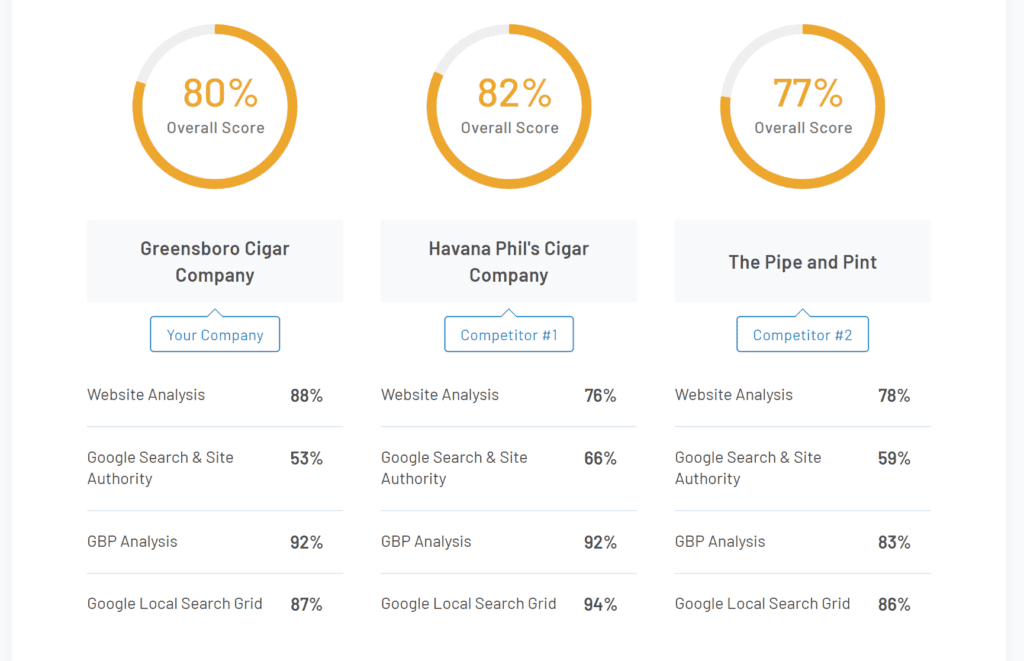
Now you CAN send this report to the prospect (not recommended at this time) but and you can use this My Web Audit feature to examine the same things later or for other purposes but for now we’re just using this information to ensure we understand the prospect’s market position and we formulate our discovery questions with that in mind.
See our YouTube channel for a video walkthrough of how this works and more details about what’s in the Competitive Analysis report.
The Key to Accurate Requirements: Formulating Strategic Questions (with AI’s help)
With your competitive analysis complete, use an AI language model to develop questions that demonstrate your insights while drawing out crucial information.
If you would like a free (for now) list of over 100 potential pre-proposal or discovery questions, I invite you to enroll in our FREE (for now) membership to
The Web Professional Project Manager’s Academy –
When we ask Chat GPT or Claude to analyze our Analysis report and modify our standard list of pre-proposal questions, it most likely will come back with strategic questions similar to this:
“I noticed your competitors are heavily emphasizing X, while your site focuses more on Y. What’s driving that differentiation strategy?”
“Company B recently launched feature Z. How has that affected customer expectations in your market?”
“Your competitors seem to be targeting [specific demographic], but your messaging appears broader. Is that intentional positioning?”
These types of questions accomplish two goals: they show you’ve done your homework, and they prompt strategic discussions that generic questions never could.
From Pre-Proposal Meeting to Winning Brief
Now it’s time to conduct the pre-proposal meeting. Armed with competitive insights and strategic questions, this meeting becomes far more productive. Rather than spending time only on basic discovery, you can dive deeper into strategic needs and opportunities. Use an AI tool like Otter.ai to record and transcribe the meeting.
After the meeting, you’ll have the transcript (and the context) needed to create a comprehensive project brief that reflects not just what the client said they want, but what they actually need based on their competitive position.
It’s important to modify this before sending it to the client and remove anything that is too specific in regard to the solution. This prevents the prospect from taking the project brief to others for an estimate. Keep the detail to yourself. Include only the information the prospect needs to confirm it is correct.
And the final step is to validate the brief with the client before moving to proposal development, ensuring complete alignment.
The Competitive Edge in Every Proposal
Using this method means the proposals you develop are more thorough, you position yourself as a consummate professional, and are more likely to the win the job because you:
- Demonstrate genuine understanding of the client’s business context
- Address competitive threats specific to the client’s situation
- Propose solutions tailored to the client’s unique market position
- Show a level of preparation that other agencies rarely match
Conclusion: Intelligence Before Action
By investing a small amount of time in competitive analysis before interviewing the prospect about their wants and needs, you transform your approach from reactive to strategic.
Understanding the competitive landscape before you pitch positions you, not just as a service provider, but as a strategic partner who brings valuable market insights from day one.
Remember: in the battle for new business, the most prepared agency usually wins.
So before you pitch, take time to spy—your win rate will thank you.