

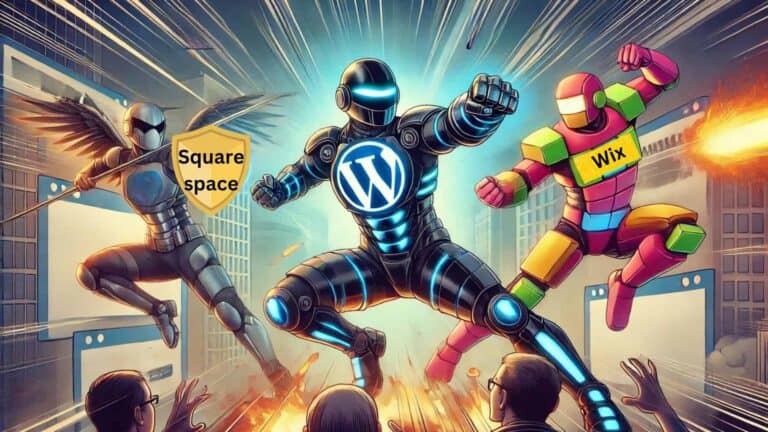
The website building landscape has undergone a huge transformation in recent years. While WordPress has long held its position as the leading content management system, platforms like Wix and Squarespace have made remarkable advances.
But, do they now pose a legitimate threat to WordPress’s market dominance? Or not?
The Gap IS Closing
WordPress folks don’t like to admit it but Wix and Squarespace have substantially improved their offerings, narrowing what was once a considerable capability gap.
Wix’s ADI (Artificial Design Intelligence) can now generate customized websites based on user preferences and industry standards. Similarly, Squarespace has enhanced its template library and expanded functionality with more robust e-commerce capabilities and third-party integrations.
Consider the case of Sarah’s Bakery, a small business that recently migrated from WordPress to Squarespace. “I was spending more time managing my WordPress site than baking,” Sarah said. “With Squarespace, I have a beautiful, functional site that I can update myself without calling my developer for every small change.”
Where Wix and Squarespace Excel
These platforms have found a competitive edge in several key areas, catering to those without a lot of technical expertise:
Ease of Use: Both platforms offer drag-and-drop interfaces that require little to no technical knowledge. This appeals to small business owners and entrepreneurs who want to maintain their own web presence themselves.
All-in-One Solutions: Unlike WordPress, which often requires multiple plugins for certain functionality, Wix and Squarespace provide comprehensive packages including hosting, security, and core features.
Design Consistency: Their curated templates can produce professional-looking results even for users with limited design skills.
Predictable Pricing: Both platforms offer transparent subscription models with no surprise costs for maintenance or updates or extra plugins.
WordPress’s Enduring Advantages
Despite the advancements by these other platforms, WordPress maintains significant advantages:
Unlimited Customization: WordPress’s open-source nature allows for virtually limitless customization that Wix and Squarespace can’t match.
Scalability: Large, complex websites with custom functionality still find a more suitable home on WordPress.
Content Ownership: WordPress offers complete control over content and data, whereas proprietary platforms maintain certain restrictions.
Community and Support: With over 40% of the web built on WordPress, its community of developers and resources remains unparalleled.
Real-World Impact
The threat to WordPress isn’t theoretical—it’s playing out in the market. Web development agencies report that clients with simpler needs increasingly choose Wix or Squarespace.
Jason Chen, founder of WebDev Solutions, notes: “Five years ago, we built everything on WordPress. Now, about 30% of our smaller clients opt for Squarespace or Wix. These platforms have matured to the point where they satisfy many basic business needs.”
The Middle Market Battleground
What’s happening in the market today isn’t necessarily a winner-take-all scenario but rather a market segmentation:
- Wix and Squarespace dominate the DIY small business segment
- WordPress maintains leadership for custom, complex, and enterprise-level projects
- The middle market—where sophisticated needs meet budget constraints—has become the primary battleground
The Answer?
Wix and Squarespace have evolved from simple website builders to legitimate WordPress alternatives for many use cases. While WordPress isn’t in danger of losing its overall market leadership, it faces genuine competition in segments where simplicity and integrated solutions are prioritized over ultimate flexibility.
For web professionals, this changing landscape presents opportunities to specialize and guide clients to the platform that truly fits their specific business needs rather than defaulting to a one-size-fits-all solution.
With the DIY capability growing every day (and the wobbly nature of the WordPress ecosystem at this time), WordPress providers would be wise to start branching out to other platforms.
The Competitive Edge in Every Proposal
Proposals developed after this process stand out because they:
- Demonstrate genuine understanding of the client’s business context
- Address competitive threats specific to the client’s situation
- Propose solutions tailored to the client’s unique market position
- Show a level of preparation that other agencies rarely match
Are ALL your projects getting done on time and within budget? If not, we got you!

Join the WP Project Manager’s Academy – a FREE membership program where you can learn everything you need to know to consistently get your projects completed on time, within budget, with features that meet the client’s business requirements WITHOUT sacrificing profit.
You might also want to Join our Facebook Group where we have weekly live trainings on all things project and productivity management.
Please note: This article may contain affiliate links that cost you nothing but help support this blog.